
Soft Robot Masters Flight, Survives Impacts

A novel lightweight robot, designed for insect like flight, has demonstrated independent takeoff capabilities and significant resistance to physical impact. Developed by Wenzhong Yan, an Assistant Professor at the University of California, Davis, with collaboration from UCLA and MIT, this micro aerial vehicle marks a departure from earlier fragile designs. Its robustness indicates potential for practical deployment outside laboratory environments.
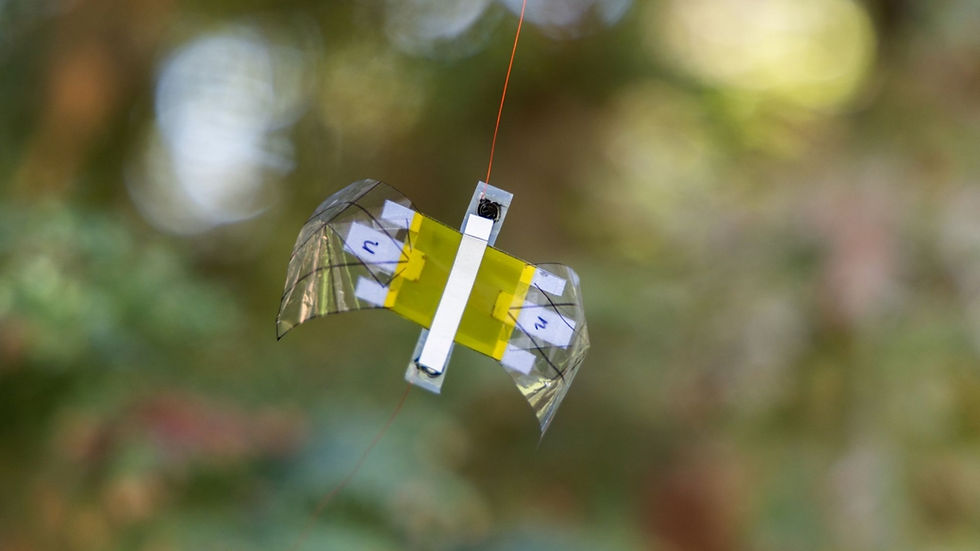
The new research, published in *Science Robotics*, details the construction and rigorous testing of this soft flying robot. Previous insect sized robots were limited to controlled research settings due to delicate components. Professor Yan stated that these robots, traditionally confined to laboratories due to fragility, now possess a resilient capability allowing them to survive in less forgiving environments.
And this resilience originates from its material and structural design. Many existing micro aerial vehicles, or MAVs, employ rigid wings and components susceptible to damage upon collision. Insects naturally possess flexible structures that absorb impact. The research team applied this biological principle, fabricating the MAV from a polymer film.
The robot weighs 185 milligrams, approximately the mass of four drops of water. Its cone shaped wings are engineered to generate lift, powered by an electrostrictive actuator. Professor Yan highlighted the material's compliant nature as crucial, noting it is very difficult to break under compression. The actuator's polymer layers flex when voltage causes expansion; rapid switching creates the necessary flapping motion.
But the soft wings also contribute significantly. They partially fold during one half of each wingbeat and reopen during the other. This action creates air resistance differences for upward lift. Furthermore, their compliant structure permits deformation under pressure without breakage, a critical feature for durability.
So, to assess the prototype's resilience, researchers subjected it to strenuous tests. It was intentionally crashed into an obstacle, struck by a flyswatter, and flattened by aluminium blocks weighing 11,000 times its own mass. The prototype recovered from every instance. Professor Yan remarked that this novel material and structure allowed the robot to survive impacts while generating sufficient aerodynamic lift, embodying what he termed "mechanical intelligence."
With this demonstration of a flexible, resilient MAV capable of takeoff, albeit connected to an external power supply, the next development phase will focus on operational refinement. Professor Yan's team plans to establish control over flight manoeuvres, including turning and landing. Increasing the MAV's payload capacity is another immediate objective.
And for real world application, future iterations will require integrated power and control systems. The current prototype relies on external wires for power. Incorporating onboard sensors or cameras will also be necessary for its utility in practical scenarios beyond the laboratory.
Professor Yan envisions substantial long term potential for this technology in natural environments. These robots could be utilised for environmental monitoring, agricultural pollination, and search and rescue missions in disaster areas. Their demonstrated ability to withstand collisions and compression means they can endure mechanical interactions with diverse surroundings.
The project involved contributions from Yuan Zhu, Hanxiang Wu, Dawei Sun, William Budiman, and Kede Liu of UCLA's Soft Materials Research Laboratory, led by Qibing Pei. Yufeng "Kevin" Chen, an associate professor from MIT, also provided expertise in micro robots.
Support for this research programme came from the Office of Naval Research, the National Science Foundation, the UCLA Academic Senate Research Allowance Programme, and the UC Davis College of Engineering. This collaborative effort represents a step towards more robust aerial robotics.
The new micro aerial vehicle can fly independently and withstand significant physical impacts.
Its design incorporates a polymer film and flexible wings, allowing deformation without breakage.
Rigorous testing involved collisions, impact from a flyswatter, and compression by blocks 11,000 times its weight, all survived.
Future work will focus on flight control, increased payload capacity, and integrating onboard power and sensors.
Potential applications include environmental monitoring, agricultural pollination, and search and rescue missions.
Source: UC Davis


