
The Wizard of Oz at Sphere: AI Redefines Classic Film Experience

"The Wizard of Oz at Sphere" is set to open off the Las Vegas Strip on Aug. 28, offering audiences a new experience of the 1939 film. Thousands will be immersed in the swirling tornado that displaces Dorothy's Kansas farmhouse into Munchkinland.
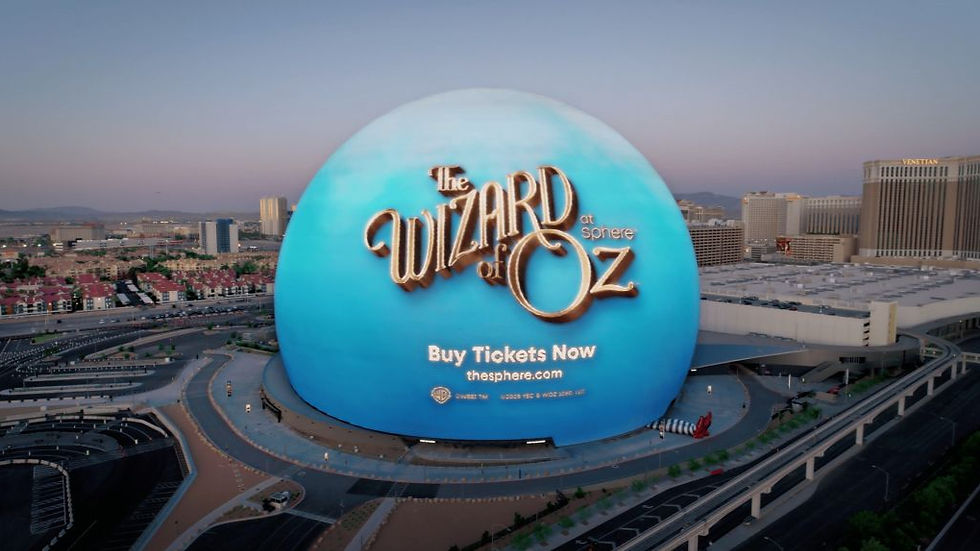
The film has been enhanced for a 14,864 square metre wall of LED panels, spanning an area equivalent to three football pitches and reaching 66 metres high. This spectacle costs USD 104 or more per seat.
This production marks a significant collaboration between a studio and technology company, utilising artificial intelligence (AI) to create a new media experience. Industry veterans view it as a potential watershed moment for AI tools in Hollywood.
Thao Nguyen, immersive arts and emerging technologies agent at CAA, stated it represents a meaningful milestone in AI-human creative collaboration. Nguyen believes it will set a precedent for reimagining culturally significant media.
Bringing the classic film to the Sphere, a globe-shaped entertainment venue featuring advanced technology, took two years. Over 2,000 people contributed to the project.
The creative team included Warner Bros. Discovery executives, Google's DeepMind researchers, academics, and visual effects artists. Development occurred amid concerns over AI's impact on jobs, with some visual effects companies initially declining involvement due to AI policies.
The project required approval from Warner Bros. Discovery CEO David Zaslav, his studio chiefs, and lawyers, who established guidelines for AI use. "Wizard of Oz at Sphere" drew upon archival materials including set blueprints, shot lists, publicity stills, and film artifacts.
The project also used approximately 60 research papers to deliver a resolution representing a ten-fold improvement over previous work. Oscar-winner Ben Grossmann oversaw the visual effects for the project.
Grossmann stated they had to reimagine the cinematography and editing without changing the experience. He noted that touching anything about "this sacred piece of cinema" would be problematic.
Instead of using AI to reduce jobs, the aim was to revitalise a classic story and create new experiences with existing intellectual property. Hollywood often embraces new technology, with many waiting to be the second to use it.
Buzz Hays, a veteran film producer who leads Google Cloud's entertainment industry solutions group, commented on the project's impact. Hays noted that "The Wizard of Oz" is providing a first opportunity for people to see AI differently.
The project commenced in 2023 following discussions among Sphere executives about projects that would push the venue's technological boundaries. The Sphere had previously hosted U2 and Darren Aronofsky's "Postcard from Earth."

"The Wizard of Oz" quickly became a top choice due to its familiarity and suitability for the Sphere's enormous canvas. Carolyn Blackwood, head of Sphere Studios, said it offered a chance to re-introduce the classic to a new generation.

The team symbolically chose a classic film that was a technical marvel for its era. "The Wizard of Oz's" dramatic transition from sepia tones to hyper-saturated colour marked a cinematic milestone.
Sphere Entertainment's CEO James Dolan and creative collaborator Jane Rosenthal, Tribeca Film Festival co-founder and film producer, envisioned a more ambitious project than simple digital remastering. Rosenthal engaged Hays to bring Google in as a technical partner.
Dolan approached Warner Bros. Discovery CEO Zaslav, a long-time friend and business partner. Zaslav, who had been impressed by the Sphere, stated that Dolan and Rosenthal also won over his studio chiefs.
Zaslav noted the project was an example of the "great IP" Warner Bros. owns. Before transferring the property, Warner Bros. established strict ground rules.
Google could train its generative AI models on each major actor to reproduce performances, but the data remained the studio's property. None of the "Oz" training data was incorporated into Google's public AI models.
Grossmann said a critical element for starting the project was creating a safe place for experimentation. He noted that Warner Brothers, Google, and the Sphere established an environment they called a "quarantine zone."
The visual effects team initially attempted enlarging images using computer-generated imagery (CGI), which would have created photorealistic animated versions of characters. This approach was rejected as it would violate the original performances' integrity.
Grossmann, whose Los Angeles studio Magnopus worked on films like Disney’s "The Lion King," stated AI was effectively a "last resort." He added that they could not achieve the desired outcome any other way.
AI enhanced the resolution of tiny celluloid frames from 1939 to ultra-high-definition images. It restored details like freckles on Dorothy's face or burlap texture on Scarecrow's face, which were obscured by Technicolor's process.
AI also helped "outpaint" on-screen images to fill gaps created by camera cuts or framing. An example includes completing the image of the woodman from a close-up of the Tin Man chopping a door of the Witch's castle with an axe to free Dorothy.
Months of fine-tuning and Google's DeepMind braintrust were required to elevate consumer-grade AI tools to deliver crisp images with the Sphere's 16K "super" resolution. Musicians re-recorded the entire film score on the original sound stage to take advantage of the venue's 167,000 speakers.
The vocal performances of Judy Garland and other actors remain unaltered. Despite attention to authenticity, the project has drawn criticism from some cinephiles who object to altering the cherished film.
Entertainment writer Joshua Rivera called the project "an affront to art and nature." Rosenthal stated that none of the critics had seen the film or understood what was being done.
Some changes are subtle, such as when Uncle Henry stands by the front door while neighbour Almira Gulch demands Toto. AI places the performer, who spends much of his time out of view, back into frame, stitching together a wider view to fill the Sphere's expansive viewing plane.
Other changes aim to realise filmmakers' original vision in ways not technically feasible 86 years ago. As Dorothy and friends encounter the Wizard, a 61 metre-high green head looms over the audience, eyes bulging and voice booming, creating a more imposing depiction than the original image of an actor in green makeup projected on smoke.
Grossmann said every change was made so the audience could directly experience what Dorothy was experiencing. He added they completed something filmmakers intended but were limited by 1939's tools.
Coordinated physical effects add another dimension, including 4-D effects. Helium-filled simians, 4.9 metres long, will swoop into the Sphere as flying monkeys, steered by drone operators.
The result is an amalgam of cinema, live production, and experiential virtual reality (VR). Grossmann believes this will change how people think about and experience entertainment.
"The Wizard of Oz at Sphere" opens Aug. 28, offering an AI-enhanced, immersive experience of the 1939 film.
The production involved over 2,000 people and a significant partnership between Warner Bros. Discovery, Google's DeepMind, and Sphere.
AI was used to enhance film resolution, restore details, and "outpaint" scenes, without altering original vocal performances.
Source: REUTERS


