Singapore Develops ALBATROSS Air-Sailing Platform for Water Monitoring

Singapore researchers have developed an unmanned platform capable of aerial deployment and autonomous surface navigation, addressing challenges in remote water monitoring. The device, known as ALBATROSS, descends from the air and transitions to a sailing vessel upon water impact. This system aims to provide rapid access to distant maritime areas, offering sustained surveillance capabilities.
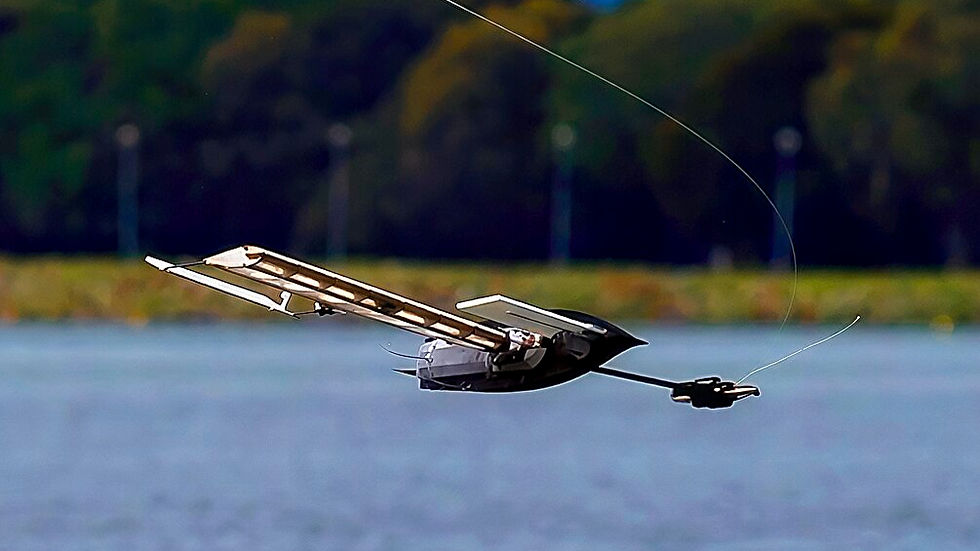
ALBATROSS, an acronym for Airborne Lander with Buoyant AuToROtating Sailing Sensor, represents a conceptual design from the Singapore University of Technology and Design, referred to as SUTD. It is engineered for swift access to remote waters and subsequent long duration monitoring of environmental conditions. Such an approach combines the advantages of aerial delivery with the endurance inherent in surface vessel operation.
And, Professor Foong Shaohui, associate head of the Engineering Product Development Pillar at SUTD, stated that while surface systems offer prolonged presence at sea, their utility is often restricted by transit times to target locations. He added that ALBATROSS was conceived to marry the speed of aerial deployment with the sustained presence afforded by sailing.
Central to the ALBATROSS design are rigid wingsails, which perform a dual function. These components are engineered to regulate the platform's descent through the air and subsequently propel it across the water. This eliminates the requirement for separate parachutes or other dedicated landing mechanisms.
During its aerial phase, the wings engage in passive autorotation, mimicking the descent pattern of a maple seed. This action serves to slow and stabilise the platform prior to water contact. Once afloat, these same wings convert into sails, harnessing wind energy for propulsion. A rudder, inspired by a fish tail, assists with steering, particularly under less favourable wind conditions.
So, the use of identical components for both aerial and marine operations simplifies the overall design, allowing ALBATROSS to transition directly from an airborne vehicle into a sailing robot. The system operates with three actuators and three navigation sensors. This contrasts with other hybrid aerial marine platforms, which typically employ six to eight actuators and more extensive sensor suites.
Dr. Shane Kyi Hla Win from Temasek Laboratories at SUTD, and lead author of the paper published in *Science Robotics*, remarked that ALBATROSS was designed to use the environment rather than oppose it. He noted its descent via passive autorotation, self righting on water through weight distribution, and subsequent wind powered movement. This simplicity, he suggested, could lead to more affordable and scalable sensing platforms for areas difficult to reach.
Field trials involved releasing ALBATROSS from an altitude of 150 metres. The platform exhibited stable autorotation during descent and achieved a low impact water landing. It then righted itself autonomously and commenced sailing without external intervention.
Researchers calculate that a comparable platform lacking autorotation would experience approximately 18.5 times more impact energy upon striking the water. This highlights the effectiveness of the passive autorotation system in mitigating landing forces.
But, once on the surface, ALBATROSS navigates autonomously between predetermined waypoints. Reservoir trials in Singapore, using a larger test model, recorded a peak sailing speed of just under 1 km/h. The platform operated for about three hours, collecting environmental data including humidity, heat levels, and wind direction.
The capacity for rapid deployment into remote waters makes the platform potentially useful for various applications. These include environmental monitoring, climate change research, search and rescue operations, and maritime security. Once deployed, its wind powered sailing capability allows sensing platforms to maintain presence in an area with minimal energy consumption.
Currently, ALBATROSS is a proof of concept, not yet prepared for open sea conditions. Testing has occurred in sheltered reservoir environments. Future versions will need to withstand stronger winds, currents, and waves prevalent in more challenging maritime settings.
Professor Foong stated that the immediate objective involves adapting the demonstrated design principles from sheltered waters for open sea operation. This requires enhancing the platform's ruggedness and durability for harsher maritime environments.
Future iterations could also incorporate a broader array of sensing equipment. This includes underwater sensors, sonar, and larger energy storage systems. The existing heavy keel and ballast provide stability for water landing and sailing. These components could be adapted in subsequent designs to accommodate additional equipment.
The dual role of the wings, assisting both descent and propulsion, demonstrates how nature inspired design can simplify the transition between air and water. This approach may facilitate faster deployment of marine sensors and prolong their operational time in inaccessible waters, according to TechXplore.
ALBATROSS is a robotic platform developed by SUTD for rapid deployment and sustained monitoring of remote waters.
Its rigid wingsails serve a dual purpose, slowing descent via passive autorotation and then acting as sails for surface propulsion.
The system uses only three actuators and three navigation sensors, a reduced number compared to other aerial marine platforms.
Field trials demonstrated stable descent, low impact water landings, and autonomous sailing capabilities in reservoir conditions.
Future development will focus on enhancing durability and sensor capacity for open sea operations.
Source: TechXplore