
Shenzhen's Robotics Industry Achieves Record Growth, Leads China

Shenzhen’s robotics industry achieved record output in 2025, rising 20% year on year to exceed 242 billion yuan (USD 35.4 billion). The city has cemented its position as China’s leading robotics powerhouse due to a sophisticated supply chain and a wide range of real-world applications.
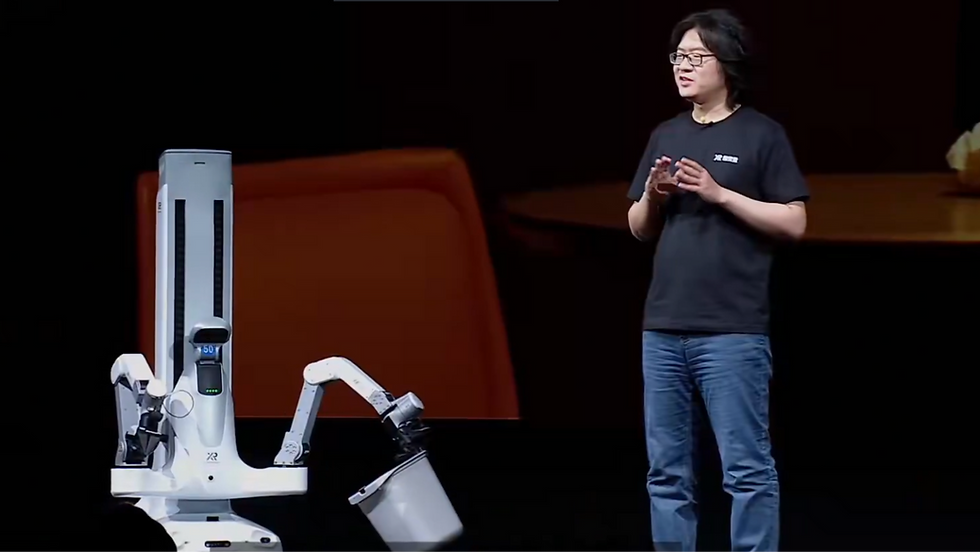
The Fair of AI and Robotics Plus (Fair Plus) trade show in Shenzhen showcased practical robotics tasks. Robots demonstrated sorting supermarket stock, serving popcorn, and transporting large boxes.
Among the displays, Shenzhen-based X Square Robot showed wheel-based humanoids using its self-developed Wall-A embodied foundation model to pick up rubbish. The Quanta X1 Pro robot, currently used in homes in Shenzhen, handles chores such as folding laundry and scooping cat litter.
Shenzhen manufactured nearly 8 million service robots last year, accounting for 43% of China’s total output in this category. The city also produced 194,900 industrial robots last year, representing a quarter of the national output, placing it at the top nationally for both core robotics categories.
The revenue of Shenzhen’s robotics industry cluster jumped 34% to 37.9 billion yuan last year. In terms of technological innovation, the city was home to 4,676 companies holding robotics-related patents in 2025, an increase of nearly 20%.
Embodied intelligence, a branch of artificial intelligence operating through a physical body, was identified for the first time by the Chinese government as a key future industry. This recognition came in a work report delivered at the annual legislative meeting in March.
Shenzhen has nurtured prominent robotics start-ups, including Engine AI, which received praise for performing the world’s first front flip by a robot. UBTech, another local firm, became the first Chinese humanoid robot maker to go public in Hong Kong.
Chief Operating Officer Yang Qian of X Square stated that Shenzhen possesses a world-leading hardware supply chain cluster that significantly shortens the cycle for customised components. Qian noted that custom parts can be delivered in days compared with months overseas.
Qian added that the costs and time required for product iteration in Shenzhen are only a tenth of those abroad. This can substantially reduce the financial and time burdens for mass production.
The local government supports the opening of industrial, retail, and community scenarios for robot deployment, enabling robotics firms to test products and iterate models quickly. X Square plans to expand its home robot line-up next month with an upgraded humanoid powered by its next-generation Wall-B foundation model.
Shenzhen's robotics industry output reached a record 242 billion yuan (USD 35.4 billion) in 2025, marking a 20% year-on-year increase.
The city leads China in both service robot and industrial robot production, manufacturing nearly 8 million service units and 194,900 industrial units last year.
Shenzhen’s advanced hardware supply chain allows for rapid, cost-effective product development and iteration.
Source: SCMP


