
MIT, EPFL Develop Puffin-Inspired Robot That Flies and Swims

Engineers from the Massachusetts Institute of Technology (MIT) and EPFL in Lausanne, Switzerland, have jointly developed a new robot capable of both aerial flight and underwater propulsion. The device, termed a "flapping-wing aerial-aquatic vehicle" (FAAV), weighs less than 300 grams and draws its design inspiration from the puffin bird.
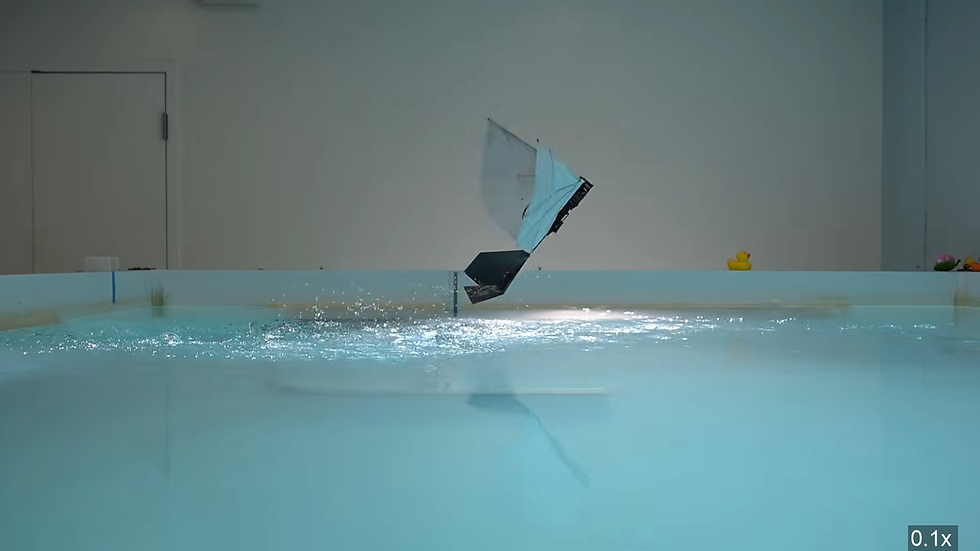
The FAAV features a central fuselage, two flexible wings, and a steerable tail. Its development focused on overcoming the challenge of creating robotic systems that can operate effectively in both air and water, a feat puffins manage naturally. Field tests conducted in Lake Geneva demonstrated the machine's ability to swim through water before flapping its wings, breaking the surface, and taking flight.
The team initially theorised that a robot operating in two mediums would necessitate complex, weighty transforming components. But their research into biological data, specifically on kingfishers, petrels, and puffins, indicated otherwise. Smaller birds maintain consistent physical mechanics across environments, adjusting only their speed. A real puffin, for instance, flaps its wings approximately ten times per second in the air, reducing this to four times per second when diving underwater.
This observed natural behaviour was emulated in the FAAV's design. The robot, powered by a small waterproof electric motor and a mechanical crankshaft, moves its flexible, nanoparticle-coated wings at a steady rate of five beats per second. This wing flexibility is cited as a crucial factor, requiring sufficient suppleness for reduced flapping amplitude underwater while retaining enough rigidity to maintain flight.
The FAAV cruises through water at a speed of 1 metre per second. In the sky, it achieves speeds of 6 metres per second. So, the engineers note that breaching the water's surface represents the most demanding aspect of the transition, requiring considerable power. To counteract surface tension, the robot must approach the surface at a steep 70-degree pitch. Shallower angles risk trapping the wingtips, while a steeper pitch can cause the drone to flip.
An interesting finding from the development process is the robot's capacity for underwater-to-air transition without the use of feet. While real puffins and ducks typically use their webbed feet to overcome water's surface tension, the FAAV successfully launches by solely manipulating its wing size, flap frequency, and tail pitch. This demonstrates that, for this robotic application, a foot-paddling manoeuvre is not required for liftoff.
Raphael Zufferey, assistant professor of mechanical engineering at MIT, articulated a future vision for the FAAV. He suggested oceanographers, marine biologists, and coastal communities could deploy the robot from boats or shore. And it would fly to areas of interest, such as icebergs or port facilities, or over whale pods, diving to collect measurements or samples before returning with data at a reduced cost compared to existing methods.
The AURA Lab at MIT is presently engaged in the subsequent development phase. Future iterations are expected to incorporate advanced wings designed for twisting and steering capabilities. These enhancements aim to enable the drone to navigate challenging conditions, including gusty winds and choppy coastal waves.
Current ocean data collection often relies on large research vessels. But these vessels frequently face limitations in safely navigating shallow reefs or breaking ice. The FAAV could provide an alternative by being deployed on an hourly basis, rather than weekly, facilitating autonomous travel between research bases and vulnerable marine ecosystems. The study detailing this development was published in the journal *Science*.
The FAAV, developed by MIT and EPFL, is a robot capable of both flight and underwater travel.
It weighs under 300 grams and is inspired by the biomechanics of puffins and other small birds.
The robot uses flexible, nanoparticle-coated wings, flapping at five beats per second, to achieve speeds of 1 metre per second underwater and 6 metres per second in the air.
Transitioning from water to air requires a steep 70-degree approach, accomplished without the need for foot-paddling.
Future iterations plan to include advanced wings for enhanced navigation in challenging environmental conditions.
Source: Interesting Engineering


