
Hefei Team Shows a Neutral Atom Quantum Design Built to Link Machines

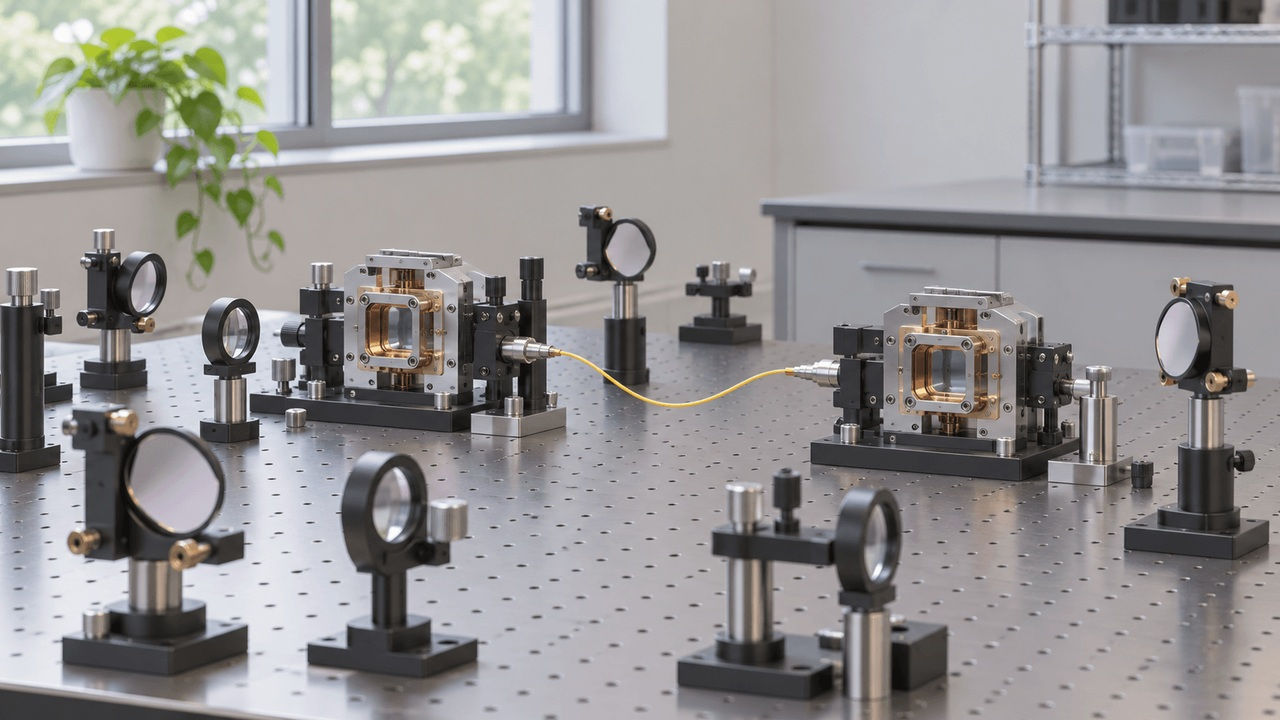
A company in Hefei has shown a neutral atom quantum computing prototype that was designed from the start to link several machines together, an approach that sidesteps the difficulty of building one very large processor by connecting smaller ones.

The team describes it as China's first neutral atom prototype with that capability built in, a claim it makes for itself rather than one backed by an independent performance record. The project grew out of research at Shanxi University, and Li Gang, a professor at the university's institute of optoelectronics and the company's chairman, said the team has developed the core components, the processor system and the interconnection technology.
And the physics explains the design choice. Neutral atom machines trap atoms in arrays of optical tweezers and use them as quantum bits, so the number of usable qubits depends on how many atoms can be held in place and addressed reliably, and the proposed route to more computing power here is to join machines rather than enlarge one.
The announcement is careful about what has not happened. There is no qubit count, no gate fidelity, no interconnection rate and no application benchmark for the prototype, and it does not demonstrate quantum advantage or fault tolerant operation, so what exists is an engineering direction rather than a measured machine.
Li said the team plans interconnection validation and demonstrations for research and industry users through a multi machine cluster, which places that work in the future and does not mean a customer can run a larger application across a production network today.
And a joint laboratory between the university and the company was opened on the same day, with stated priorities covering optical tweezer atom arrays, the interfaces between machines and core optical components, which is the unglamorous work that decides whether linking machines is practical.
But the missing numbers are the story for anyone judging the claim. In quantum computing a prototype announcement without a qubit count or a fidelity figure cannot be compared with anything, and a first of its kind claim about architecture is the easiest kind to make and the hardest to check.
So treat this as a research programme that has chosen its direction and published no results yet. The test will be the interconnection demonstrations the team says are coming, and whether joining two machines produces a measurable gain over running one.
A Hefei company showed a neutral atom prototype built for multi machine links
The team describes it as China's first with interconnection designed in from the start
The project came out of research at Shanxi University under Li Gang
No qubit count, fidelity, interconnection rate or benchmark was disclosed
A joint university laboratory opened the same day to work on atom arrays and interfaces
Source: Pandaily


