DeepSeek V4.1 Flash Cuts AI Costs With Strong Agent Benchmarks

DeepSeek has released V4.1 Flash, a multimodal AI model designed to cut inference and memory costs while competing with larger systems on coding, cybersecurity and agent benchmarks. The Chinese developer says its new Causal Encoder-Decoder architecture activates only 8 billion parameters when processing input and 16 billion when generating output, despite using a 552 billion-parameter mixture-of-experts backbone and supporting contexts of up to one million tokens.
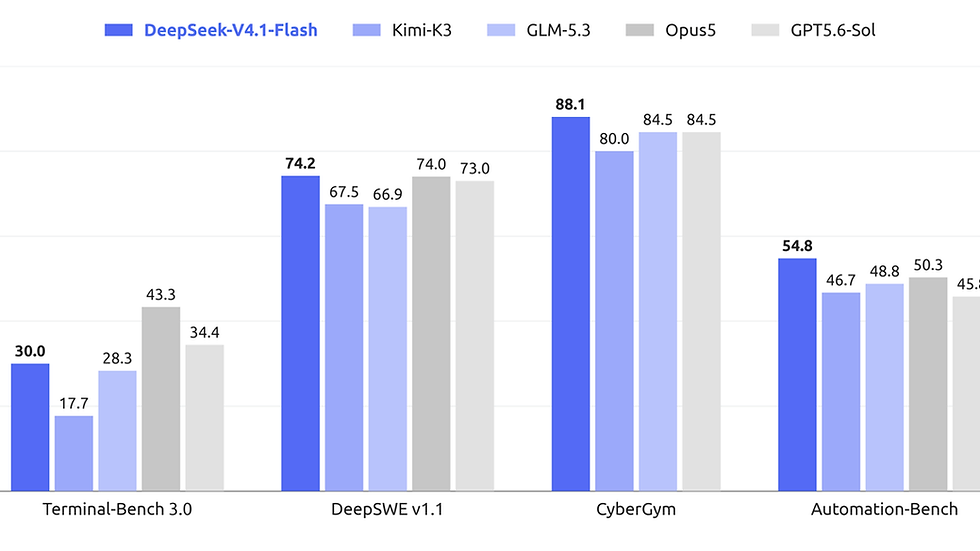
In results published by DeepSeek, V4.1 Flash scored 90.6 on Terminal-Bench 2.1, which measures performance on computer tasks. That exceeded Moonshot AI's Kimi K3 at 88.3, OpenAI's GPT-5.6 Sol at 88.8 and DeepSeek's larger V4 Pro at 87.9.
The company also reported a score of 88.1 on the CyberGym security benchmark, compared with 80.0 for Kimi K3 and 84.5 for GPT-5.6 Sol. On DeepSWE v1.1, a software-engineering agent benchmark, V4.1 Flash recorded 74.2, ahead of Kimi K3 at 67.5 and narrowly above several frontier competitors.
V4.1 Flash uses a mixture-of-experts design, which routes work through a subset of the model rather than activating the entire network for every token. DeepSeek says its compressed key-value cache requires about one-quarter of the high-bandwidth memory and one-eighth of the solid-state storage used by the previous V4 Flash generation.
The model can process both images and text, and its weights are available on Hugging Face under the MIT licence. Developers can access it through DeepSeek's API by selecting the deepseek-flash model name.
DeepSeek has retired V4 Flash and its experimental vision variant, with their existing API identifiers temporarily redirected to V4.1 Flash. The company also plans to route V4 Pro requests to the new model from 14 September while it develops V4.1 Pro.
The comparisons should be treated as developer-reported results. Benchmark scores can change with the testing framework, agent scaffold, reasoning settings and sampling method, so independent evaluation will be important before firms rely on the model for security-sensitive or production coding work.
The launch reflects a wider push among Chinese AI developers to improve performance without matching the computing demands of the industry's largest systems, a priority as advanced chip access remains constrained and inference costs become increasingly important.
Source: SCMP