
Chinese Robotaxi Firms Accelerate Global Expansion With Cost Edge

Chinese robotaxi firms Pony AI and WeRide are accelerating global roll-outs of commercial fleets. This expansion leverages cost competitiveness derived from the country’s world-leading new energy vehicle supply chain. Improved operational efficiency also supports these efforts, company executives said.

China’s new energy vehicle supply chain has helped reduce the total cost of Pony AI’s upgraded seventh-generation robotaxi. This cost, including the base vehicle, battery, and autonomous driving kit, is now below 230,000 yuan, or USD 33,700, according to James Peng.
This price point makes it cheaper than a basic Tesla Model 3, which is the US electric vehicle giant’s most affordable car. James Peng, founder and Chief Executive Officer of the Guangzhou-based robotaxi firm Pony AI, stated on Friday, the opening day of the Beijing Auto Show, which runs until May 3, "We will push China’s autonomous driving technology to every corner of the world with overwhelming cost competitiveness."
Peng added that Pony AI’s technological strength has also helped drive down prices, supporting wider adoption of robotaxis. The company’s latest model is set to hit the market next year.
Peng described robotaxis as a new mode of transport rather than simply driverless taxis. He presented them as private, safe mobile spaces for work, leisure, and daily travel, enhancing urban mobility.
Cross-town rival WeRide is also increasing its investment in autonomous vehicles. On Monday, the company announced one of the industry’s most ambitious plans: to deploy approximately 200,000 autonomous vehicles, including robotaxis, on roads worldwide over the next five years.
This ambitious plan will be achieved through a deepened tie-up with technology powerhouse Lenovo Group. WeRide did not provide a specific breakdown of how many robotaxis would be included by the end of the period.
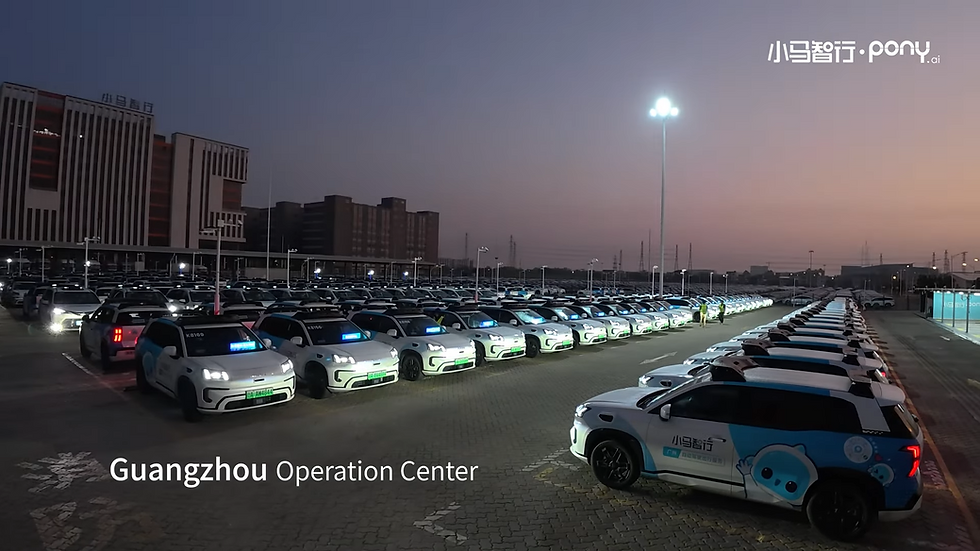
The company previously aimed to deploy 2,600 robotaxis worldwide by the end of 2026. This compares with Pony AI’s target of 3,000 robotaxis.
Autonomous driving was entering a critical phase of commercial deployment, with competition shifting from technological capability to cost efficiency and the ability to scale operations. Tony Han Xu, founder and Chief Executive Officer of WeRide, said this in a statement.
The large-scale roll-out of Level 4 autonomous vehicles was supported in part by WeRide’s third-generation high-performance computing platform. This platform was expected to cut autonomous driving system costs by 50%, according to the statement.
In the six levels of vehicle autonomy, Level 4 refers to a stage where human intervention is not required in most circumstances. Chinese robotaxi firms had been expanding overseas partly because local regulators remained cautious about opening up larger areas in tier-one cities for commercial operations.
Alex Yao, equity analyst at JP Morgan, stated in a research note that the industry’s development hinged on hardware cost reduction, algorithm sophistication, and government support in terms of operational areas. Yao added that Chinese-made robotaxis had already reached a commercially viable cost level.
The Middle East has emerged as a hub for pilot projects, where local interests and Chinese firms’ expansion plans intersect. Peng acknowledged that while the Middle East conflict had delayed shipments of Pony AI’s vehicles, local partners remained "very committed" to the partnership.
Chinese robotaxi firms Pony AI and WeRide are rapidly expanding global commercial fleets.
This expansion is driven by cost competitiveness, stemming from China’s new energy vehicle supply chain, and improved operational efficiency.
Pony AI’s robotaxi costs below 230,000 yuan, or USD 33,700, making it more affordable than a basic Tesla Model 3.
Source: SCMP


