
Chinese AI Surges with Alibaba, DeepSeek Leading Open-Weight Race

China's Alibaba recently introduced its most substantial artificial intelligence model to date, driving a surge in its share price. Simultaneously, research firm Artificial Analysis reported DeepSeek's newest product features aggressive pricing, more than 100 times cheaper than Anthropic's Claude Fable 5. These developments highlight the rapid progress in AI made by Chinese technology firms.
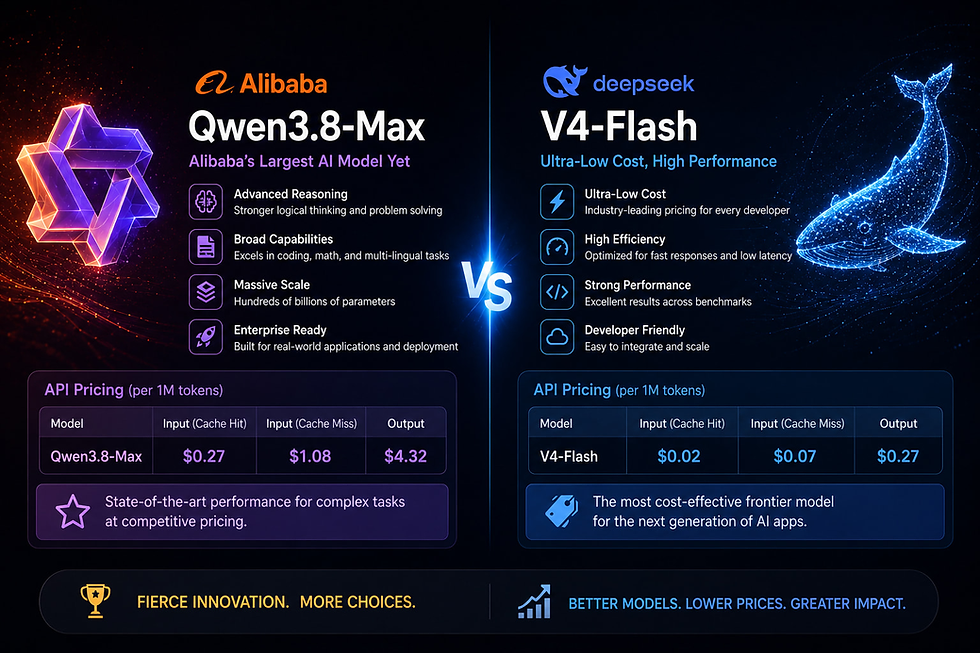
Chinese tech firms are engaged in a competitive effort to construct powerful systems while maintaining manageable operating costs. Alibaba's Qwen3.8-Max and DeepSeek's V4-Flash both demonstrate a commitment to open weight models. These firms aim to build appeal among developers globally. Lian Jye Su, chief analyst at Omdia, stated many business workflows do not require the industry's highest performing model; they need models that are sufficient, affordable, transparent, and accessible. Open weight models assist in meeting this market demand.
An open weight model provides the underlying learned settings, which developers can download to operate or adapt the system. By contrast, OpenAI, Anthropic, and Google employ closed source models. And Alibaba's new Qwen3.8-Max quickly ascended leaderboards that assess AI model capabilities following its recent announcement. This helped its shares increase by seven percent in Hong Kong trade.
The Qwen3.8-Max model contains 2.4 trillion parameters. These numerical settings allow a model to learn from data, recognise patterns, generate responses, and complete tasks. This places it behind domestic competitor Moonshot AI's Kimi K3, introduced last month with 2.8 trillion parameters. A greater parameter figure does not automatically signify a better model. However, it remains a closely observed indicator of the scale of computing and data behind advanced AI systems.
Qwen3.8-Max was presented on Arena.AI, a crowdsourced model comparison platform. It soon became the highest ranking Chinese model for text based applications. The model currently trails Claude Fable 5 and three Opus variants, all from Anthropic. But on Arena.AI's leaderboard for AI models that analyse images and other visual content, Qwen3.8-Max achieved second place globally, behind only a Claude Fable 5 variant.
Both Qwen3.8-Max and Kimi K3 are capable of processing text, images, and video. They can handle up to 1 million tokens at one time. Tokens are discrete units of data, often representing parts of words or short words. A large token capacity indicates the model's ability to ingest substantial amounts of material in a single operation. This includes lengthy legal documents, extensive software codebases, or hundreds of pages of written material.
The tech giant indicated the Qwen3.8-Max model, scheduled for release next week, completed a software engineering project in 16 days. It operates using a "mixture of experts" design. This design allocates work among specialised sections of the system instead of activating the entire model for each request. So, only 95 billion parameters are utilised at any given time, which reduces both operational costs and response delays for devs.
DeepSeek's V4-Flash model, released recently, ranks as the least expensive to operate on benchmark tests among prominent global models, according to research firm Artificial Analysis. The startup, which sources suggest is preparing for a potential initial public offering, saw its R1 and V3 models gain attention in early 2025. This triggered a selloff in global tech stocks. It also prompted questions regarding the expenditure by US companies on AI development.
V4-Flash charges USD 0.14 per million input tokens and USD 0.28 per million output tokens, according to Artificial Analysis, a firm based in San Francisco. The firm calculated V4-Flash's average cost at 3 cents per test, compared with 86 cents for Kimi K3, USD 1.86 for OpenAI's GPT-5.6 Sol, and USD 3.15 for Claude Fable 5. This offers a more accurate measure of value than pricing alone.
It accounts for the quantity of data a model must process and generate to complete a task. A model with a low published price may still prove costly if it demands considerably more steps to produce an answer. According to Reuters, these developments illustrate a dynamic shift in the artificial intelligence sector, particularly among Chinese tech firms.
Alibaba introduced its Qwen3.8-Max model, possessing 2.4 trillion parameters, impacting its share value.
DeepSeek's V4-Flash model offers significantly lower operational costs compared to competitors, charging 3 cents per test on average.
Both Chinese models are open weight, aiming for greater appeal among global developers.
Qwen3.8-Max ranks highly in AI model leaderboards for both text and visual capabilities.
The Chinese AI sector shows rapid advancement in developing powerful yet affordable systems.
Source: Reuters


