
China Targets Household Chores with New Humanoid Robots

Commercial humanoid robots in China are set to expand beyond factory settings into the complex world of domestic household chores, including laundry, bed-making, and elder care. Companies are actively improving the data required for robots to perform these intricate tasks, some of which necessitate embodied artificial intelligence (AI).
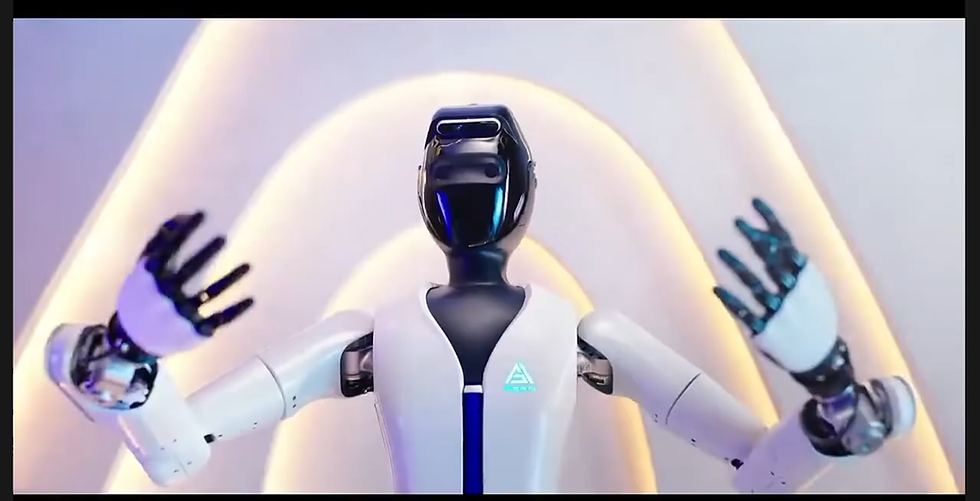
GigaAI, in collaboration with the Hubei Humanoid Robot Innovation Centre and the Hubei Humanoid Robotics Industry Alliance, unveiled the country’s first general-purpose household humanoid robot model, the SeeLight S1.
GigaAI Chief Executive Officer Zhu Zheng indicated that the robot would be provided to families for free testing in Wuhan, the capital of China’s central Hubei province, as early as the first half of 2027, according to an article published on Thursday in local newspaper Changjiang Daily.
A company video showed the two-armed, wheeled robot performing various tasks such as chopping vegetables, frying eggs, loading a washing machine, hanging laundry, making a bed, and opening curtains.
Mr. Zhu stated that developers aim to reduce the hardware price of the S1 to below USD 14,700 by June 2027, effectively halving its current cost. He foresees significant breakthroughs in both commercialisation and embodied AI model capabilities for household robots by 2028.
Unlike industrial humanoid robots that rely on hard-coded algorithms and pre-configured routines, the S1 is designed to autonomously comprehend tasks and plan its execution trajectory with the aid of embodied artificial intelligence models.
A fleet of 100 S1s will be trialed at housing reserved for employees in hi-tech industries starting later this month, before a pilot in Wuhan households. This later pilot will focus on families with elderly members, children, or pets.
For safety, Mr. Zhu mentioned that the machine is equipped with a “compliant control mechanism” which immediately freezes the robot upon encountering pets or children.
The global household robot market, which reached an estimated USD 41 billion last year, is expected to grow annually by 20% by 2027, according to research firm LeadLeo. Robot vacuum cleaners currently dominate this market, with no commercially available humanoid models for household errands.
While some major Chinese developers have deployed products in laboratories and factories, the use of humanoid robots in industrial and agricultural scenarios is developing quickly, Unitree Robotics founder and Chief Executive Officer Wang Xingxing previously stated.
Mr. Wang added that despite significant potential for home use, it remains challenging at this stage. Zeroth founder and Chief Executive Officer Guo Renjie noted that home environments are non-standardised and constantly changing for a robot.
Mr. Guo also highlighted that household robots require special size specifications and small joint modules to reduce weight. Domestic settings are data-scarce compared to industrial environments, but this situation is improving.
OneRobotics, a Shenzhen-based company whose mission is to “bring AI robots into every household,” earlier this week announced a 45-million-yuan deal. The agreement is to help collect data for diverse scenarios, including household chores, elder care, and retail spaces.
OneRobotics, which listed in Hong Kong in December, will deploy its proprietary OneRo H1 robots for this project. The company stated the initiative would collect data from real-life, high-frequency tasks such as storage, tidying, and retrieval across household spaces including kitchens, bedrooms, bathrooms, and balconies. This aligns with its core strategy of focusing on embodied intelligence at home, the company said in a statement on Monday.
China’s GigaAI unveiled the SeeLight S1, a new humanoid robot designed for domestic chores.
The SeeLight S1 will undergo free testing with families in Wuhan, China, from the first half of 2027.
GigaAI aims to lower the robot’s hardware cost to below USD 14,700 by June 2027.
Source: SCMP


