
China's Long March 10B Achieves Historic First Flight Recovery

The Long March 10B rocket recently completed a successful first flight recovery, accelerating competition within China's commercial space sector. Firms like LandSpace and JianYuan aim for reflight milestones by the close of the current year. This marks a critical phase for the industry.
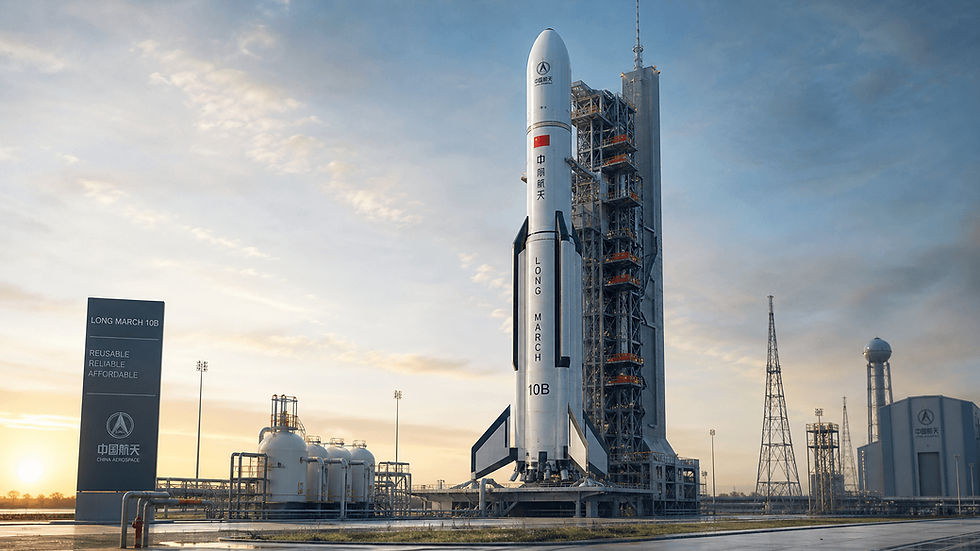
The successful first flight recovery of the Long March 10B established a new benchmark for China's commercial space organisations. The principal challenge now involves demonstrating that a recovered booster can be quickly, reliably, and cost effectively reflown. The CZ-10B achieved the first maiden flight rocket recovery globally on a 144 metre sea platform positioned 431 kilometres from Wenchang. This contrasts with SpaceX Falcon 9, which did not recover on its initial flight, and Blue Origin's New Glenn, which only achieved recovery on its second attempt.
Commercial rocket companies in China are now actively pursuing reflight capabilities. LandSpace Zhuque-3, a stainless steel liquid oxygen methane rocket utilising landing leg recovery akin to Falcon 9, is preparing for a second recovery attempt. Its first effort in a previous December encountered an anomaly during final descent. And static fire testing for the Zhuque-3 Y2 was completed earlier this June. If this attempt proves successful, China would be the first nation to demonstrate both net recovery and landing leg recovery systems.
JianYuan Technology's YX-1 is pursuing a distinct method: offshore chopstick capture. This involves mechanical arms on a sea platform. The approach combines the rapid turnaround benefits observed with Starship tower capture and the inherent safety and flexibility of maritime operations. The YX-1 successfully demonstrated controlled splashdown recovery in a previous May. Its recovered engine subsequently underwent four hot fire tests, validating the full flight splashdown recovery reignition process.
But the financial implications of each recovery method vary considerably. Net recovery necessitates a complex sea platform but permits lighter rockets by removing landing leg dead weight. Chopstick capture provides the swiftest turnaround, potentially within hours rather than days. Landing legs are an established technology, yet they reduce available payload capacity. All three strategies confront the fundamental requirement of proving multi flight reusability. SpaceX has documented over 600 Falcon 9 landings and 602 reflights. China, considering all its national programmes, currently possesses a single recovery.
Industry analysts suggest that reusability becomes economically viable following five reuses. But achieving more than ten reuses requires addressing engine life longevity, thermal protection integrity, structural fatigue, and the corrosive effects of salt from sea based operations. The CZ-10B design aims for more than ten reuses with a 72 hour turnaround. Blue Origin's recent issues with New Glenn provide a cautionary example. A second flight booster delivered a payload to an incorrect orbit, and a subsequent test stand explosion destroyed its sole launch pad, illustrating the disparity between engineering demonstration and dependable operational use.
So the market reacted immediately to the CZ-10B recovery. According to Pandaily, on the day of its retrieval, 25 commercial aerospace stocks reached their daily price limits across Shanghai and Shenzhen exchanges. The China Aerospace ETF recorded a rise of 5.74 per cent, with trading volume three times its 20 day average. The technical validation phase for China's reusable rockets has concluded; the commercial validation phase has only just commenced. This indicates a shift in focus for the industry.
China's Long March 10B successfully completed its first flight recovery on a sea platform.
Chinese commercial firms LandSpace and JianYuan are developing distinct rocket recovery technologies.
LandSpace aims for a second landing leg recovery attempt for its Zhuque-3 rocket following a previous anomaly.
JianYuan Technology is advancing an offshore chopstick capture system for its YX-1 vehicle.
The Chinese reusable rocket sector has concluded its technical validation, with commercial viability now being the primary objective.
Source: Pandaily


