300 Humanoids at Work in a Theme Park

AGIBOT has put more than 300 humanoid robots on regular daily duty at Chimelong's Spaceship Park in Zhuhai, in southern China. The company says the machines now cover seven kinds of work at more than 100 interaction points across the park and its hotel. That range runs from entertainment shows and science education to guidance and way finding, service and retail stations, companion tours, hotel duties, and sports competitions staged for guests.
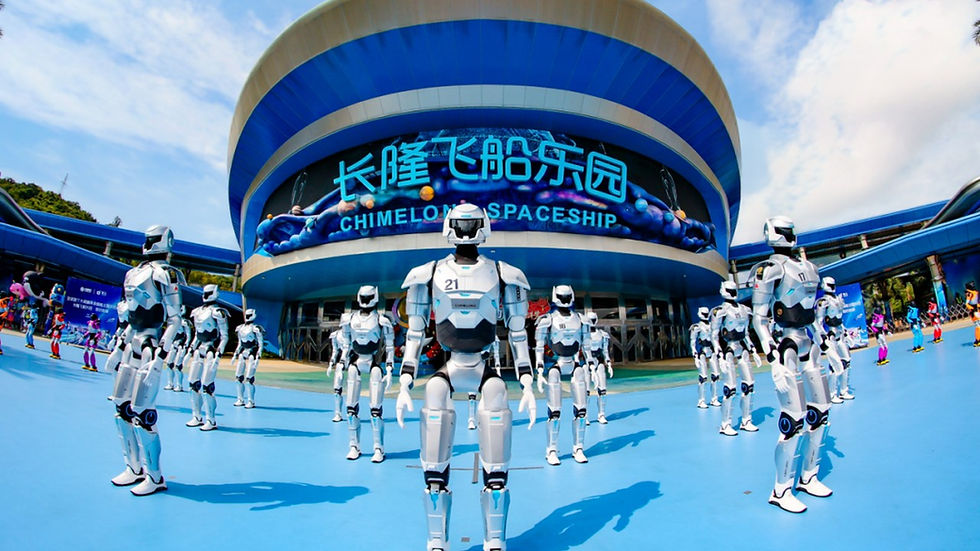
AGIBOT says each robot can switch language and dialect to match the guest standing in front of it, which matters in a venue that draws both domestic and international visitors. The fleet is not a display. These machines are on a roster.
The handover also carried a production milestone. AGIBOT's 20,000th robot, an Expedition A3 Ultra, went to the same park, roughly six months after the company's 10,000th unit. And the 15,000th unit went somewhere else entirely, to an industrial production line rather than a tourism venue.
Humanoid robots are not rare on conference stages. What is rare is a fleet this size doing work a theme park would otherwise pay people to do, day after day, in a public venue with unpredictable crowds. A short trade show routine is one test, and a hundred consecutive shifts is another.
Deployment also exposes everything a demonstration can hide, including battery and recharge cycles, wear on joints and hands, the cost and skill of maintenance in the field, and the steady supply of spare parts. Above all it surfaces the safety question of machines sharing space with families and children in a crowded public venue.
The park runs a dedicated 5G Advanced network built with China Mobile, according to AGIBOT, and robot traffic and visitor traffic sit on two separate logical networks. And the intent is that a packed parade route degrades neither the robot's responsiveness nor a guest's connection. GSMA describes 5G Advanced as the next phase of the 5G standard, with more capacity and lower latency.
Chimelong and AGIBOT also unveiled a joint research institute for embodied artificial intelligence in cultural tourism. But the operational record that matters, uptime, maintenance load, and safety in a crowd, has not been published. The park is being positioned as a testbed as much as a customer.
Unit counts record what has been built, while destinations record where the machines are asked to earn their keep. Industrial deployments tend to be repetitive, controlled, and measurable, which makes them easy to justify on throughput and hard to turn into a demonstration of anything a factory could not already automate. Service deployments are messier, and they reach far more ordinary users.
Three questions remain open. No uptime figures have been published, so the working day of a single unit is unknown. And no pricing, cost breakdown, or visitor safety data has been released for the deployment.
Watch for independent reporting from inside the park, and for reliability figures that do not come from the vendor. And the joint institute will be worth tracking if it produces research a rival's machines could not already match.
More than 300 AGIBOT humanoid robots are on regular daily duty at Chimelong's Spaceship Park in Zhuhai.
The deployment covers seven kinds of work at more than 100 interaction points.
AGIBOT's 20,000th unit went to the park, while the 15,000th went to an industrial production line.
AGIBOT says a dedicated 5G Advanced network keeps robot and guest traffic on separate logical networks.
No uptime, cost per shift, or visitor safety figures have been published for the deployment.
Source: Pandaily